



Resource Persons and Institutions
Dr. Amra Raza
 Dr. Amra Raza is an Associate Professor and Chairperson of the Department of English Language and Literature, University of the Punjab. She is a creative writer, teacher trainer and researcher. She holds the Jane Townsend Poetry Prize (1990) and is the co-editor of Voices and Visions: Young Writers From Pakistan. Her poems and research articles have been published in Pakistan and abroad.
Arfa Sayeda Zehra
 Arfa Sayeda Zehra has been a Professor for over forty years and has been intimately associated with issues dealing with women‟s education and empowerment. She continues to teach as visiting faculty. Presently, Dr. Arfa serves as Chair of the National Commission on the Status of Women, Government of Pakistan. This puts her at the center of discussions about socio-cultural issues in national and international policies that focus on the empowerment of women. Dr. Zehra got her doctorate in History from the University of Hawaii in 1983 and was a fellow at the East-West Center between 1978 and 1983. She is a member of the Law and Justice Commission of Pakistan, a Federal Government institution, established under an Ordinance (XIV) of 1979. The Commission is headed by the Chief Justice of Pakistan and comprises 12 other members.
Anita Ghulam Ali
 Anita Ghulam Ali has been the Chief Executive of the Sindh Education Foundation (SEF) since the 4th of October, 1992. This set up undertakes various educational initiatives and consultancies both for local and international organizations. Professor Ali has contributed innumerable exposes on education, development and civil society to many leading national English and Urdu daily newspapers; and several research and analytical assignments. Professor Ali was appointed as Minister for Education, Culture, Science, Technology, Youth and Sports twice. She was later also appointed as the Advisor on Education to the Governor. Prof. Ali is a recipient of the Sitara-e-Imtiaz award for her lifetime contribution to educational and community development issues of the country.
Asif Farrukhi
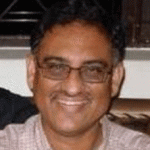 Asif Farrukhi is a literary critic, translator, and fiction writer. He has translated widely from English into Urdu and vice versa and has edited and compiled many anthologies of the writings of Pakistani authors. He also writes on literature for Dawn and other newspapers and periodicals. Asif has published six collections of short stories and two collections of literary criticisms. He is currently editing and publishing a literary miscellany in Urdu called Duniyazad. He has been awarded the Tamgha-e-Imtiaz for his literary contributions.
Nargis Sultana
 Nargis Sultana is currently working with Foundation Open Society Institute (FOSI) - Pakistan. She has vast experience of working in education sector, governance, other social sectors and research on social and economic related issues.
During her academic career, she received several awards and distinctions. She has a number of publications to her credit, some of which have been published in the Pakistan Development Review, the country's leading journal of economic research. She has also co-authored a book entitled Pakistan's Economic Performance: 1947 to 1993 - A Descriptive Analysis.
She has worked as Education Specialist at MSU/World Bank, Senior Programme Officer (Education) in DFID, Research Manager in IFPRI/USAID, and also worked with FAO/UNDP.
Fahmida Riaz
 Fahmida Riaz is a well-known poet and writer. Her works have been translated into many languages. She has written several poems and stories for children and some of them are published in textbooks for children. She was given the Himmett-Hellman award for writers by Human Rights Watch, New York, in 1997. The Government of Sindh gave her the Shaikh Ayaz award and the Government of Pakistan gave her the award of Pride of Performance in 2011.
Dr. Hamida Khuhro
 Dr Hamida Khuhro is an intellectual, a teacher and a woman of action and purpose. She graduates from the University of Karachi, Sindh and Cambridge in England. She did her doctorate from London University. She left University teaching to concentrate on writing and politics. She has twice served as Minister for Education and Literacy, Government of Sindh. She has also served as Member and Chairperson of several political, academic, and government committees. Her publications are as follow; · The Making of Modern Sindh · Mohammad Ayub Khuhro: Life of Courage in Politics. · Papers of The Separation of Sind from Bombay Presidency ( Institute of History and Culture, Islamabad )
Among her edited works are Sindh through the Centuries (OUP, 1981), and as well as a number of colonial texts. She has contributed numerous articles in learned journals and newspapers and has been founder editor of Grassroots, a journal of Pakistan Studies, University of Sindh. She has edited the Arts Journal, University of Sindh, and has revived the Journal of the Sindh Historical Society.
Rumana Husain
 Rumana Husain co-founder of the Book group in 1988, focusing on children‟s Urdu language books. She has written and illustrated over 40 children‟s books and numerous teacher‟s manuals for the Book group, Oxford University Press, the Education Research and Development Centre (ERDC) and for Peak Publications. She has conducted a number of teacher-training workshops in Pakistan. In October 2010 she was invited to attend a children‟s book festival in South Korea as an illustrator for a Peace Story book, an anthology with 22 stories from around the world. She is the author of the book „Karachi wala: a subcontinent within a city’ -a coffee-table book about Karachi‟s communities, and is a co-founder and Senior Editor of Nukta Art, a biannual (international) magazine for contemporary arts published since 2005. From 2001 to 2008 she worked as Head, Activist and Outreach of an NGO, the Children’s Museum for Peace and Human Rights (CMPHR). From 1986 to 1996 she was Headmistress of the junior section of The C.A.S School, and later as the senior school‟s Vice Principal. She has taught art, environmental studies and illustrations at the Karachi Grammar School, The C.A.S School, and the Indus Valley School of Art & Architecture respectively. She is the founding editor of AYE Karachi! - A bilingual quarterly city guide and features magazine.
Shahina Alvi
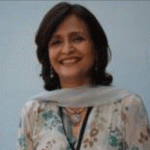 Shahina Alvi has been in the field of special education for the last 25 years. She was one of the first remedial tutors to be trained at (READ). Other than her teaching experiences, she also screens children for dyslexia and is also one of the course leaders for the teacher training course at READ – the six-month READ DIPLOMA COURSE. She is presently
serving as the CEO of READ.
Mona Qaiser
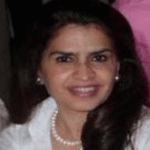 Mona Qaiser is a Remedial Therapist and Director of R.E.A. Dyslexics (Pvt) Ltd. She is one of the course leaders for the READ Diploma Course and carries out Educational Evaluations for children with learning difficulties and conducts workshops for teachers and students in various aspect
Fauzia Minallah
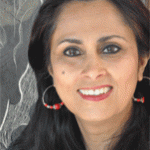 Fauzia Aziz Minallah is an Islamabad based writer/ illustrator of Children's books. She is the creator of cartoon character Amai, the bird of light. She is the author of followings:
-> Amai's Wish
-> Sadako's Prayer
-> Children of Light.
Her book Sadako's Prayer is published in Japanese, Dari, Urdu and English and is the winner of Hiroshima citizen's Award as well as the Ron Kovic Peace Prize. She is founder of Funkor Child art Centre that promotes Children's art and book reading and distributes picture books free of charge among children in crisis.
Nigar Nazar
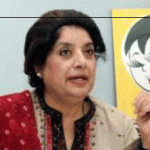 NIgar Nazar is the CEO of Gogi Studios PVT-LTD A graduate of Punjab University, she went on the Full bright scholarship for professional up-gradation. Her achievements include: a recent fellowship in Colorado College USA; Solo exhibition with PNCA, Shakir Ali Museum Lahore, Karachi Arts Council, and Abbasin Arts Council Peshawar. Nigar created Gogi comics for national dailies such as Jang, Dawn, The News and The Muslim. Bus wrapping with Gogi Cartoons took place in 2004, i.e. 9 buses in Twin Cities and 3 buses in Lahore and 2 coasters. She also prepared cartoon murals for 3 hospitals in Islamabad and Rawalpindi including PIMS, CGH, and DHQ. Nigar authored 7 comic books and illustrated and authored 8 books for different national and international organizations. She has experience in conducting workshops and outreach programs in schools for the underprivileged students, to date 6000 children have been addressed through this program. Nigar was invited to be on the jury in Turkey, China, Malaysia, and Algiers. The Government of Pakistan conferred on her Fatima Jinnah award for her contribution in the field of Art.
Rabia Garib
The idea of Toffee TV stems from arduous hours of searching Urdu stories and songs for children similar to that of Cassette Kahani. As the search continues, a sad realization has set in, that our heritage has simply not been captured in the realm of providing our children with the opportunity of learning the Urdu language through imagination. We are uploading these treasures through YouTube, a public resource, to promote the Urdu language. Content on this site is free as our way of sharing our heritage as widely as possible. The stories and songs you will at Toffee TV are an attempt to help, inspire and change in learning language. We love listening to stories and even more, sharing them. Most of these stories have been located in ragged books found in old book bazaars of Karachi, interpreted and transformed in digitized mode to share them with the online world. ToffeeTV.com is run by Talea Zafar (Chief Illustrator) and Rabia Garib (Chief Wrapper)
Ismat Riaz
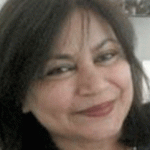 Ismat Riaz is a veteran in the field of education, having served as a teacher, teacher trainer, and academic coordinator. A graduate of Kinnaird College, Lahore, Ismat has an M.A. in Curriculum, Pedagogy and Assessment from the Institute of Education, University of London, UK. She has been a consultant for Pakistan Studies with UCIE, and also for Oxford University Press, Pakistan for Pakistan Studies and secondary history. Her articles on education are published in leading national newspapers.
Sania Saeed
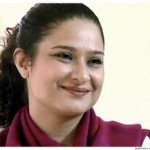 Sania Saeed is acclaimed and respected as one of the most versatile actors of television and theatre in recent times. She has been acting since the age of ten, doing social and community theatre with her parents and made her first television appearance in 1988. Her interest in issues of women and children was obvious from the beginning. Sania is a Psychology graduate and has most effectively utilized her education in all her projects. As an actor she makes conscious attempts to empathize with her characters. As a host and moderator, she is aware of the power of effectively constructed questions and listening. She believes in what she is doing and only does what she believes in. Her emotional awareness and communication skills stand her apart from all her contemporaries.
Zara Mumtaz
 Children‟s author, Zara Mumtaz, had her first piece published in the daily DAWN, when she herself was a twelve-year-old. It was a tragic-comical poem about the Punjab floods, raging beneath the railway carriage in which she was going home for the holidays. Now she is the author of four books, each book accompanied with an audio-recording, published by OUP, Pakistan . Zara Mumtaz is also a well-known children‟s playwright. She wrote her first children‟s play (on the environment) for WWF, Pakistan in 1992. This was followed by a number of plays for the stage as well as an award-winning television serial, Peeli Kothi. In 1992, she launched the Agahi Awareness Children‟s Theatre (ACT) under the aegis of which summer theatre workshops were held for the next 10 years that brought together privileged and under-privileged children, most times in the environs of the Children‟s Library Complex. In 2010, ACT was revived in Karachi and currently works with a number of
educational institutions and NGOs in the staging of original children‟s plays. This year, 2011, OUP is set to launch Zara Mumtaz‟s collection of ten folk-stories, passed down to us through the oral tradition, entitled „Anna Bua ki Kahaniyan‟ These stories have made Mumtaz quite popular in Karachi schools and literary festivals as a story–teller.
Mohammad Mikail Soomro
 Mikail's responsibilities as the coordinator, School Outreach Tour at the Citizens Archive of Pakistan primarily revolve around the School Outreach Tour and all that the program encompasses. Throughout the week, he conducts classes at under-resourced government schools, where the SOT team teaches students about the rich history of Pakistan using fun and alternative teaching methods to develop critical thinking skills. Apart from regular classes he conducts workshops for students and teachers where they are introduced to the SOT curriculum.
Raza Rumi
 Raza Rumi is a freelance writer from Lahore, Pakistan. He writes regularly for the Pakistani weekly The Friday Times, The News and Dawnon myriad topics such as history, arts, literature, and society. Raza blogs at Jahane Rumi, a website devoted to Sufi thought, the arts, literature, and cultures of South Asia . He also edits a cyber-magazine Pak Tea House. Raza has worked in Pakistan and abroad in various organizations including multilateral institutions such as the United Nations.
David Martin
 David Martin has been the Director the British Council, Pakistan since 2009. This is one of the British Council‟s largest operations, with over 200 staff in three main offices in Karachi, Lahore and Islamabad. In Pakistan the Council focuses on providing opportunity for young people through programmes in education, youth engagement and English language. In the last year it has encouraged a policy debate on the issue of language in education. David‟s previous overseas postings have been as Director in Hungary, Zimbabwe and the Palestinian Territories, and in Nigeria as Deputy Director. Earlier in his career David was an education adviser in the British Council headquarters and he started his career as a teacher in a large comprehensive school in England.
Mohammad Zubair aka Zubair Torwali
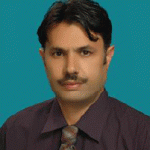 He is the Executive Director of Idara Baraye Taleem-o-Taraqi (IBT) since 2007 in Swat. Idara Baraye Taleem-o-Taraqi (IBT) I am a prolific writer on many issues from education to current affairs. I write for The News, Dawn, The Express Tribune, The Friday Times, Daily Times, The Viewpoint, The Faultlines, The Frontier Post, The Statesman etc. I am involved in a number of activities including social activism, human rights protection moves and writing articles on a variety of topics from extremism to politics and current affairs and education. I am also interested in developmental and organizational issues including trust building, leadership skills, conflict resolution and personality tracks. To this end I have undergone the online courses on leadership and conflict resolution offered by LEAD Pakistan, and international network working on capacity building environmental sustainability.
Khalida Brohi
 Khalida Brohi is a 23 year old with already 6 years of great experience in Human Rights Activism and Social Entrepreneurship. Starting her career at the fragile age of 16, she stood up to fight the custom of Honour Killings in her community, later running the campaign WAKE UP Campaign against honour killing and her current Program called Sughar Women Program. Sughar Program focuses
on promoting women entrepreneurship in tribal areas of Pakistan to end the custom of Honor Killing by Training and building the capacities of women in value adding the traditional embroidery and using it as a source of creating small businesses. Under this program women are also provided basic education and life skills to understand their true rights and status in the society. With the successful take off of Sughar, Khalida plans to change the lives of 1 million women in Pakistan. Khalida has been awarded the Young Champion Award by University of Singapore, The Unreasonable Institute Fellowship Award, The YouthActionNet Fellowship Award and Foundation for Young Social Entrepreneurship Fellowship Award. Along with her roles as a student and social entrepreneur she is the eldest sister of 8 siblings and a Global Speaker for Girls Fight Back USA.
Dr. Yaqoob Khan Bangash
 A graduate of the University of Notre Dame, with a PhD from the University of Oxford, Dr Bangash is a scholar of modern South Asia. His research focuses on the creation of Pakistan, creation of national and regional identities, and human rights issues. Presently, he is Commissioning Editor at Oxford University Press and Assistant Professor of History at Forman Christian College.
Huma Mirza
 Huma Mirza is currently working as Senior Education Advisor- CIDA. With over 25 years of experience in the education sector Huma Mirza has worked in both public and private sector institutions across Pakistan-from Karachi to Gilgit. As a development expert in education she has served with the World Bank, DFID, USAID and CIDA in long term leading positions. Her expertise in education includes strategic management, pre and in service teacher education with a focus on trainings, curriculum and materials development and inclusive education. Prior to taking up development as a career, Huma Mirza served as a faculty member at the Aga Khan University, Karachi and as Senior Editor School Books at Oxford University Press. She was a member of the pioneer team that set up the Fauji Foundation Teachers Training Institute, Rawalpindi. Huma has a pro poor approach to life and seeks to create and support initiatives that foster happiness, creativity and hope for the poor and marginalized children and youth of Pakistan. She is the
patron of “Happy Hearts Children‟s Activity Room” set up at Punjab Institute of Cardiology, Lahore and also supports a chain of reading rooms set up in Government Colleges of Elementary Teachers in Multan and Lahore. She is a member of the governing body of Sulaimaniya Orphanage for Boys, Samanabad, Lahore. Huma Mirza has a Master‟s degree in English Literature, from Punjab University, Masters in Teaching of English as Foreign Language from Allama Iqbal Open University, Islamabad, Teachers Training Certificate from Chester College For Higher Education, Chester, UK. She has to her credit a number of research studies. She is the co-author of children‟s book on inclusion “Just Like the other Kids” (Urdu and English versions).
Samar Minallah
 Samar is one of the first Pakistani filmmakers who used video to give voices to the marginalized by making socially relevant documentaries. Her first documentary in Pushtu titled “Swara-Da Zhwand Mairman” challenged giving of girls as compensation to end disputes. The documentary was a catalyst in pushing a law against the custom of ‘Swara’. The film was used as evidence in the first ever Supreme Court Case highlighting the issue.
She is the winner of several awards for highlighting this culturally sanctioned form of violence through her films.
Nasreen Iqbal
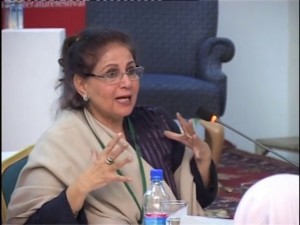 Director of Pesh Raft Foundation, Grammar School Rawalpindi (GSR) and Centre for Peace and Human Rights Education.
Rafi Peer Theatre
 Rafi Peer Theatre Workshop is the oldest independent theatre/puppet company of Pakistan. It was founded in 1974 as a Not for Profit Organization and is the only group in Pakistan which is organizing Major International Arts Festivals. In 1992, Rafi Peer Theatre staged its first Puppet Festival and during the last 13 years it has produced 19 international festivals of Puppetry, Theatre, Dance, Music and Film. These festivals have featured over 3000 performances by approximately 3000 artists from more than 59 countries. Their World Arts performing and Visual Arts Festival consist of many forms and styles of Theatre, Dance, Music, Puppets, Film from traditional to contemporary arts which serves as a meeting point for Eastern and Western Musicians, Dancers, Puppeteers, Theatre Artists, and Film Makers.
Sheema Kermani
 Sheema Kermani, the founder of Tehrik-e-Niswan, is a classical dancer, teacher, drama artist and women‟s rights activist. For Sheema, dance and theatre is a passion as well as a social cause. She teaches dancing and drama and also acts for the stage and television. She combines this with activism which includes Mobile Theatre in low- income areas. She is Pakistan‟s leading performance artist. Tehrik-e-Niswan is a Cultural Action Group using the medium of Theatre and Performing Arts to bring awareness on Right‟s issues. It is the oldest theatre group in Pakistan and has been consistently providing quality and meaningful theatre since the last 33 years. Tehrik-e-Niswan has raised the standards of Performance Arts and performed at International Festivals and Conferences. For The Children‟s Literature Festival in Lahore, Tehrik-e-Niswan is presenting its musical production „Jungle Jungle Zindabad‟, based on a poem by the well-known writer Vikram Seth. This Urdu version has been translated and adapted by Fahmida Riaz and produced by Tehrik-e-Niswan and directed by Sheema Kermani.